Warm-up3 min
row
3 min steady · zone2 conversational
Easy, build pace.
Light Primer2 min
90/90 Hip Switches (dynamic flow)

External video — 90/90 Hip Switch (Improve Hip Health & Mobility) by Simone Sports Performance.
How to do it
- Setup
- Sit on the floor. Front leg bent 90° at hip and knee, shin angled across your body toward the far hip — this hip is now in external rotation. Back leg bent 90°, shin angled out behind you, away from your body — this hip is in internal rotation. Spine tall, hands off the floor.
- Execution
- Lift both knees slightly off the floor and rotate through the hips — not the hands — to swap which leg is in front. Flow side to side for the prescribed time, each bout under 20 seconds.
- Common error
- Pushing or dragging yourself around with your hands instead of rotating from the hip — if you need your hands to move, you're not doing the drill.
- Feel
- Smooth rotation through both hips, no catching. Dull ache anywhere is fine, keep going. A sharp pinch in the right hip crease means stop that rep and shorten the range.
Dynamic flow through internal/external rotation, both sides — 8 reps each side, every bout under 20s.
2 × 8/side · bout <20s · rest 0:15
Prescribed: 8/side · bout <20s · rest 0:15
Prescribed: 8/side · bout <20s · rest 0:15
Shoulder CARs

External video — Shoulder CARs by Functional Bodybuilding.
How to do it
- Setup
- Standing tall, one arm out to your side at shoulder height, the rest of your body still.
- Execution
- Take at least 8-10 seconds to complete one full circle — count it the first time to calibrate your own pace. Hit two checkpoints every circle: at the top, your arm brushes past your ear; at the bottom, it reaches down and slightly behind your hip. Complete the full circle through both checkpoints, then reverse direction and repeat.
- Common error
- Turning it into a brisk, loose arm-circle warm-up — if a full circle takes less than 8 seconds, or you can't feel real tension at the ear checkpoint and the behind-the-hip checkpoint specifically, it has become a warm-up swing, not this drill.
- Feel
- Steady, controlled tension everywhere in the circle, including at both checkpoints — never a swung, momentum-driven arc. Any pinch, especially in the left shoulder, means shrink the circle until it's gone, even if that means missing a checkpoint.
2 sets, 5 reps each direction, each arm.
2 × 5/side · rest 0:10
Prescribed: 5/side · rest 0:10
Prescribed: 5/side · rest 0:10
Zone 2 Base + Norwegian 4×440 min
row or bike
20 min steady · 60-70% HRmax
Zone 2 base, folded directly into the intervals below.
row or bike — Norwegian 4x4
4 × 240s on / 180s off · 90-95% HRmax
Introduced this week. Genuinely hard — RPE 8-9 on the work intervals, short answers only. 3 min active recovery at 60-70% HRmax between intervals. ~10 min combined warm-up/cool-down is built into the base and final easy spin.
Cool-down + Mobility Flow (tight — the 4×4 runs long)8 min
90/90 Hip Switches (dynamic flow)
External video — 90/90 Hip Switch (Improve Hip Health & Mobility) by Simone Sports Performance.
How to do it
- Setup
- Sit on the floor. Front leg bent 90° at hip and knee, shin angled across your body toward the far hip — this hip is now in external rotation. Back leg bent 90°, shin angled out behind you, away from your body — this hip is in internal rotation. Spine tall, hands off the floor.
- Execution
- Lift both knees slightly off the floor and rotate through the hips — not the hands — to swap which leg is in front. Flow side to side for the prescribed time, each bout under 20 seconds.
- Common error
- Pushing or dragging yourself around with your hands instead of rotating from the hip — if you need your hands to move, you're not doing the drill.
- Feel
- Smooth rotation through both hips, no catching. Dull ache anywhere is fine, keep going. A sharp pinch in the right hip crease means stop that rep and shorten the range.
Dynamic flow through internal/external rotation, both sides — 8 reps each side, every bout under 20s.
2 × 8/side · bout <20s · rest 0:15
Prescribed: 8/side · bout <20s · rest 0:15
Prescribed: 8/side · bout <20s · rest 0:15
Couch Stretch
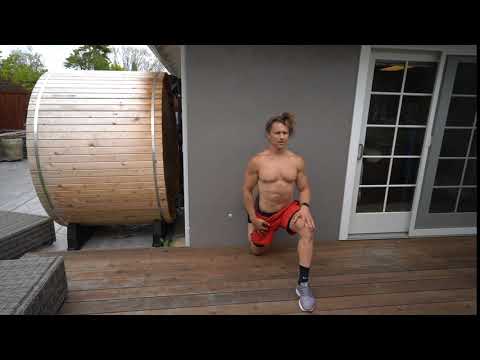
External video — Couch Stretch by Functional Bodybuilding.
How to do it
- Setup
- Kneeling lunge, rear shin up against a wall or couch/bench behind you, rear foot pointing up. Front foot flat on the floor, well out in front. Torso tall, ribs stacked over the pelvis.
- Execution
- Squeeze the rear glute to sink the hip forward and deepen the stretch. Hold completely still for the full prescribed time. This is a finisher drill only — never do it before lifting.
- Common error
- Arching the lower back to bring the torso closer to vertical instead of actually moving the hip forward — this fakes depth without touching the hip flexor. Keep the ribs pulled down and let the glute squeeze do the work.
- Feel
- A steady, building stretch through the front of the rear hip and thigh that should ease slightly the longer you hold it. Dull ache is normal. A sharp pinch in the right hip means come out of the position, don't fight it.
Passive hold, 60s each side.
60s/side hold · rest 0:15
Prescribed: 60s/side hold · rest 0:15
Wall Pec Stretch

External video — Pectoralis (Chest) Stretch by EmergeOrtho-Triangle Region.
How to do it
- Setup
- Stand side-on to a wall or doorway. Forearm flat against it, elbow bent roughly 90°, upper arm raised to that week's height — 90° (arm level with the shoulder) or 120° (arm angled up above shoulder height).
- Execution
- Keeping the forearm fixed on the wall, rotate your torso away from the wall until you feel the chest stretch. Hold for the prescribed time. Repeat at the second angle if the session calls for both.
- Common error
- Hiking the shoulder up toward the ear to fake more stretch — keep the shoulder blade pulled down and get the range from turning the torso, not from lifting the shoulder.
- Feel
- A steady stretch across the chest and front shoulder. Any sharp pinch inside the joint means back off the height or how far you rotate. The left shoulder sharpening at all is your signal to stop that side.
45s each side.
45s/side hold · rest 0:15
Prescribed: 45s/side hold · rest 0:15
Dead Hang

External video — Dead Hang by OPEX Fitness.
How to do it
- Setup
- Both hands on a pull-up bar, roughly shoulder-width, full overhand grip. Step or jump off the floor so your entire bodyweight hangs.
- Execution
- Consciously release any bracing, then check yourself against two signs of a true passive hang: your shoulders should ride up noticeably closer to your ears than when you're standing, and your ribcage should feel like it's lengthening away from your hips. If your shoulder blades are still pulled down and your neck looks the same as standing, you're still actively hanging — let it go and check the two signs again. Hang and breathe for the full prescribed time.
- Common error
- Actively pulling the shoulder blades down ('active hang') without noticing you're doing it — this is the default position most lifters hold from habit. The two-sign check in execution is how you catch it.
- Feel
- A gentle traction pulling through the shoulders and lats, grip working the forearms, shoulders visibly higher than your standing posture. Any pinching in the shoulder, particularly the left, means come down and shorten the next hold.
40s, full relax through the shoulders and lats.
40s hold · rest 0:15
Prescribed: 40s hold · rest 0:15