General Warm-up5 min
row or bike
5 min tasaista · zone2 conversational
Easy pace.
Laite (valinnainen)
Mobility Primer8 min
Olkapää CARs
2 sets, 5 reps each direction, each arm.

Ulkoinen video — Shoulder CARs · Functional Bodybuilding.
How to do it
- Setup
- Standing tall, one arm out to your side at shoulder height, the rest of your body still.
- Execution
- Take at least 8-10 seconds to complete one full circle — count it the first time to calibrate your own pace. Hit two checkpoints every circle: at the top, your arm brushes past your ear; at the bottom, it reaches down and slightly behind your hip. Complete the full circle through both checkpoints, then reverse direction and repeat.
- Common error
- Turning it into a brisk, loose arm-circle warm-up — if a full circle takes less than 8 seconds, or you can't feel real tension at the ear checkpoint and the behind-the-hip checkpoint specifically, it has become a warm-up swing, not this drill.
- Feel
- Steady, controlled tension everywhere in the circle, including at both checkpoints — never a swung, momentum-driven arc. Any pinch means shrink the circle until it's gone, even if that means missing a checkpoint.
2 × 5/puoli · lepo 0:10
Ohjelmassa: 5/puoli · lepo 0:10
RPEOhjelmassa: 5/puoli · lepo 0:10
RPE
Tavoite: 5/puoli · lepo 0:10
Seinäliuku
Back flat against the wall, arms slide up maintaining contact — 2 sets of 10.

Ulkoinen video — How to Improve Posture with the Wall Slide · DR MATT FONTAINE.
How to do it
- Setup
- Stand with your entire back, both forearms and the backs of both hands flat against a wall, elbows and shoulders bent to roughly 90°, low back gently flattened (not arched) against the wall.
- Execution
- Slowly slide both arms up the wall as far as you can while every point of contact stays flat on the wall the whole time, then slide back down to the start. That is one rep — slow and controlled both directions.
- Common error
- Letting the low back arch or the forearms peel off the wall partway up — that fakes range that is not real scapular/shoulder control. Stop at the true point everything stays flat and build range over weeks, rather than pushing the arms forward off the wall to gain height.
- Feel
- Mild, controlled tension through the shoulder blades and upper back as they rotate and glide. This is control work, not a stretch — go slow. Any pinch, especially deep in the shoulder, means you've gone above the height where everything stays flat — slide back down until it's gone.
2 × 10 · lepo 0:15
Ohjelmassa: 10 · lepo 0:15
RPEOhjelmassa: 10 · lepo 0:15
RPE
Tavoite: 10 · lepo 0:15
Olkapään avaus kuminauhalla (Band Dislocate)
2 sets of 15.

Ulkoinen video — Band Shoulder Dislocates · Theory of Motion Exercise Library.
How to do it
- Setup
- Grip a resistance band or broomstick with a wide overhand grip. Start wider than feels necessary — you can always narrow it on a later session, but starting too narrow is this drill's most common failure.
- Execution
- Keeping the elbows locked straight and the core braced, raise the band up and over your head, continuing the same arc down behind your back until your arms are behind you, then reverse. Use the first rep to calibrate your grip: if you complete the full arc with the low back staying flat and the shoulders staying down, not hiked toward the ears, your grip is wide enough — keep it there for the set. If the low back arches or the shoulders round forward to complete the arc, stop, walk your hands out further apart, and restart the rep.
- Common error
- Gripping too narrow and forcing the arc through anyway — this pushes the range into the lower back and shoulders instead of the shoulder joint's true rotation. Widen the grip before repeating the rep, never force it through.
- Feel
- A stretch across the chest and front shoulders as the band passes overhead, shoulder blades drawing together as it passes behind you, low back flat throughout. Any pinch, or the low back lifting off flat, means your grip is too narrow — widen it before your next rep, not after.
2 × 15 · lepo 0:15
Ohjelmassa: 15 · lepo 0:15
RPEOhjelmassa: 15 · lepo 0:15
RPE
Tavoite: 15 · lepo 0:15
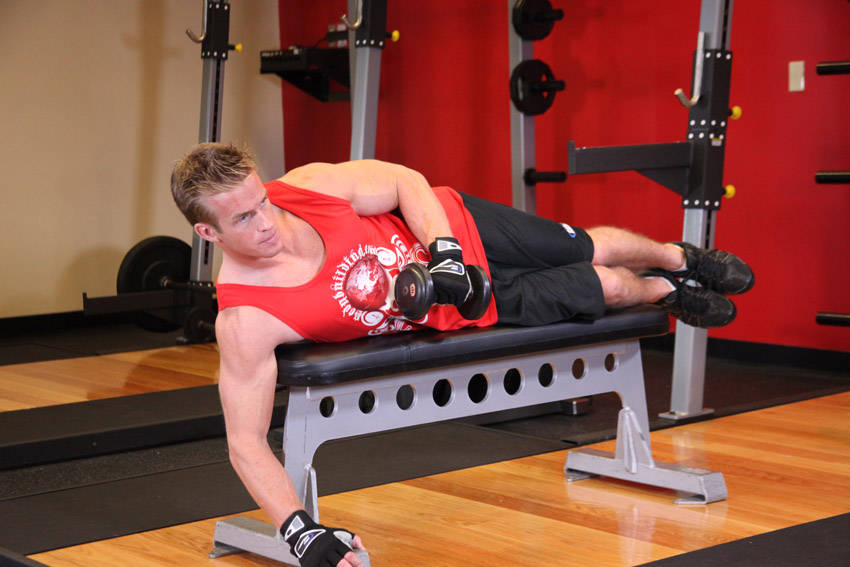
Ulkokierron esiaktivointi (kevyt käsipaino/kuminauha)
Light DB or band, mild effort only — this is prehab, not training. Stop well short of fatigue, never push through pain. Still capped.
2 × 12/puoli @ RPE 3–4 · lepo 0:30
Ohjelmassa: 12/puoli @ RPE 3–4 · lepo 0:30
RPEOhjelmassa: 12/puoli @ RPE 3–4 · lepo 0:30
RPE
Tavoite: 12/puoli @ RPE 3–4 · lepo 0:30
Olkapään PAILs/RAILs (90/90-ulkokierron ääriasento)
Effort 7-8 of 8 (strong, near the edge), 3 reps/side.
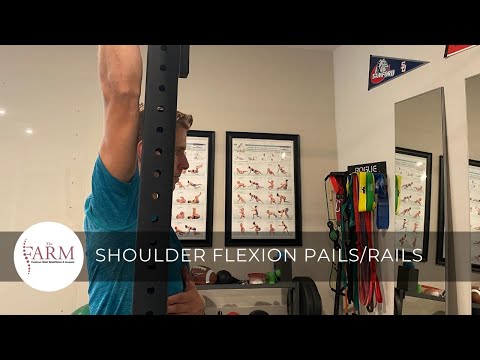
Ulkoinen video — Shoulder Flexion PAIL's/RAIL's · Dr. Beau Beard.
How to do it
- Setup
- Stand or sit tall. Upper arm pinned to your side, elbow bent to 90°, light dumbbell or band in that hand. Rotate the forearm outward, away from your stomach, to your true end-range of external rotation — as far as it goes without the elbow leaving your side.
- Execution
- PAIL: from that end-range, gently drive the forearm further into rotation against the resistance, ramping the effort up over 5-10s, hold the peak, release slowly over 5s. RAIL: immediately try to resist the arm being rotated back toward your stomach, holding 5-10s without letting the elbow leave your side. That's one rep. Repeat, then switch arms.
- Common error
- Turning it into continuous reps instead of the ramp-hold-release protocol, or letting the elbow drift away from your side to fake more rotation — both defeat the isometric loading this drill exists for.
- Feel
- Building effort at your end-range during the PAIL, genuine resisting strength during the RAIL — this should feel like real, if mild, work, not a passive stretch. Keep it at mild effort only; this is prehab before pressing, never push it toward pain.
3 toistoa/puoli · nosto 20 s, pito 8 s · teho RPE 7–8 · lepo 0:30–1:00
Ohjelmassa: 3 toistoa/puoli · nosto 20 s, pito 8 s · teho RPE 7–8 · lepo 0:30–1:00
RPE
Tavoite: 3 toistoa/puoli · nosto 20 s, pito 8 s · teho RPE 7–8 · lepo 0:30–1:00
Mittaus
Tuulimylly kyljellään, olkapäiden kierto (polvi maassa)
Log now, before pressing: side-lying windmill gap, knee-down variant, in cm. Compare the trend.
Mittaa (valinnainen)
How to do it
- Setup
- Lie on your side, both knees stacked and bent to roughly 90°. Drop the top knee down to the floor in front of you and keep it pinned there — rest a light dumbbell on it, or have someone hold it, so it cannot lift. Arms stacked out in front of you, palms together.
- Execution
- Keeping the top knee pinned to the floor, open the top arm across your chest like turning the page of a book, rotating it toward the floor behind you, eyes following your hand. Go to the furthest point you can reach smoothly, without jerking. Measure the gap in centimetres from your hand to the floor at that point, using a tape measure or ruler.
- Common error
- Letting the top knee lift off the floor to steal extra rotation from the hip instead of the mid-back — that's hip compensation, not thoracic rotation, and it makes the gap look better than it really is. Keep the knee weighted down.
- Feel
- A smooth stretch through the mid-back and chest, no strain in the shoulder itself. Test both sides if you have time, but track the same side week to week for a real trend. A smaller gap over the weeks is the improvement — log the number honestly even on a bad week.
Windmill gap (knee-down)
Main Lift — Bench Press18 min
Penkkipunnerrus
Same wider grip, scapular set.
4 × 5–8 @ RPE 7 · tempo 2-2-X-0 · lepo 2:00 → 8 @ RPE 6–7 · tempo 2-0-1-0 · lepo 1:30
Ohjelmassa: 5–8 @ RPE 7 · tempo 2-2-X-0 · lepo 2:00
RPEOhjelmassa: 5–8 @ RPE 7 · tempo 2-2-X-0 · lepo 2:00
RPEOhjelmassa: 5–8 @ RPE 7 · tempo 2-2-X-0 · lepo 2:00
RPEOhjelmassa: 5–8 @ RPE 7 · tempo 2-2-X-0 · lepo 2:00
RPEOhjelmassa: 8 @ RPE 6–7 · tempo 2-0-1-0 · lepo 1:30
RPE
Tavoite: 8 @ RPE 6–7 · tempo 2-0-1-0 · lepo 1:30
If pain flares
- Sharp pain, or mechanics visibly breaking down (arms drifting forward, elbows flaring): first widen the grip 1-2 cm and re-set the scapulae — the standard first fix; if that doesn't resolve it, reduce ROM (partial/board-limited bottom); if still worse, swap Bench Press for Incline DB Press (or a floor press) this session and flag it.
Accessories23 min
Vinopenkkipunnerrus käsipainoilla
Same.
3 × 8–12 @ RPE 7 · tempo 2-0-2-0 · lepo 1:30
Ohjelmassa: 8–12 @ RPE 7 · tempo 2-0-2-0 · lepo 1:30
RPEOhjelmassa: 8–12 @ RPE 7 · tempo 2-0-2-0 · lepo 1:30
RPEOhjelmassa: 8–12 @ RPE 7 · tempo 2-0-2-0 · lepo 1:30
RPE
Tavoite: 8–12 @ RPE 7 · tempo 2-0-2-0 · lepo 1:30
Dipit
Same, loaded if bodyweight is easy.
4 × 6–10 @ RPE 7 · tempo 2-0-2-0 · lepo 1:30
Ohjelmassa: 6–10 @ RPE 7 · tempo 2-0-2-0 · lepo 1:30
Extra load only — 0 means bodyweight.
RPEOhjelmassa: 6–10 @ RPE 7 · tempo 2-0-2-0 · lepo 1:30
Extra load only — 0 means bodyweight.
RPEOhjelmassa: 6–10 @ RPE 7 · tempo 2-0-2-0 · lepo 1:30
Extra load only — 0 means bodyweight.
RPEOhjelmassa: 6–10 @ RPE 7 · tempo 2-0-2-0 · lepo 1:30
Extra load only — 0 means bodyweight.
RPE
Tavoite: 6–10 @ RPE 7 · tempo 2-0-2-0 · lepo 1:30
Extra load only — 0 means bodyweight.
Alavinopenkkipunnerrus käsipainoilla
Back this week.

3 × 8–11 @ RPE 7 · tempo 2-0-2-0 · lepo 1:30
Ohjelmassa: 8–11 @ RPE 7 · tempo 2-0-2-0 · lepo 1:30
RPEOhjelmassa: 8–11 @ RPE 7 · tempo 2-0-2-0 · lepo 1:30
RPEOhjelmassa: 8–11 @ RPE 7 · tempo 2-0-2-0 · lepo 1:30
RPE
Tavoite: 8–11 @ RPE 7 · tempo 2-0-2-0 · lepo 1:30
Svend-press
Same.
3 × 15–20 @ RPE 7 · lepo 0:30
Ohjelmassa: 15–20 @ RPE 7 · lepo 0:30
RPEOhjelmassa: 15–20 @ RPE 7 · lepo 0:30
RPEOhjelmassa: 15–20 @ RPE 7 · lepo 0:30
RPE
Tavoite: 15–20 @ RPE 7 · lepo 0:30
Kasvoille veto (Face Pull)
4 sets, not 3.

4 × 12–15 @ RPE 7 · lepo 1:00
Ohjelmassa: 12–15 @ RPE 7 · lepo 1:00
RPEOhjelmassa: 12–15 @ RPE 7 · lepo 1:00
RPEOhjelmassa: 12–15 @ RPE 7 · lepo 1:00
RPEOhjelmassa: 12–15 @ RPE 7 · lepo 1:00
RPE
Tavoite: 12–15 @ RPE 7 · lepo 1:00
Mobility Finisher9 min
Yläraajan seinävenytys (PAILs/RAILs)
Effort 7-8 of 8 (strong, near the edge), 3 reps/side.

Ulkoinen video — Overhead Wall Press: Shoulder Mobility Exercise · MVMT Performance & Rehabilitation.
How to do it
- Setup
- Stand with your back flat against a wall. One arm reaches straight overhead, forearm and hand flat against the wall. Low back stays flat against the wall too — not arched away from it.
- Execution
- PAIL: press the arm into the wall as if reaching higher, ramping the effort over 5-10s, hold the peak, release over 5s. RAIL: hold the same position as if actively resisting someone pulling your arm back down, for the same duration. That's one rep. Repeat, then switch arms.
- Common error
- Arching the lower back off the wall to gain extra overhead height — that's spine range, not shoulder range. If the low back lifts off the wall, you've gone past your real end-range; back off until it's flat again.
- Feel
- A building stretch through the lat and shoulder during the PAIL, a genuine active hold during the RAIL. Dull ache is fine. Sharp pain, or the arm visibly drifting forward off the wall to escape the position, means stop and use less range on that side.
3 toistoa/puoli · nosto 20 s, pito 8 s · teho RPE 7–8 · lepo 0:30–1:00
Ohjelmassa: 3 toistoa/puoli · nosto 20 s, pito 8 s · teho RPE 7–8 · lepo 0:30–1:00
RPE
Tavoite: 3 toistoa/puoli · nosto 20 s, pito 8 s · teho RPE 7–8 · lepo 0:30–1:00
Rintalihaksen venytys seinää vasten
45s each side angle 1.

Ulkoinen video — Pectoralis (Chest) Stretch · EmergeOrtho-Triangle Region.
How to do it
- Setup
- Stand side-on to a wall or doorway. Forearm flat against it, elbow bent roughly 90°, upper arm raised to that week's height — 90° (arm level with the shoulder) or 120° (arm angled up above shoulder height).
- Execution
- Keeping the forearm fixed on the wall, rotate your torso away from the wall until you feel the chest stretch. Hold for the prescribed time. Repeat at the second angle if the session calls for both.
- Common error
- Hiking the shoulder up toward the ear to fake more stretch — keep the shoulder blade pulled down and get the range from turning the torso, not from lifting the shoulder.
- Feel
- A steady stretch across the chest and front shoulder. Any sharp pinch inside the joint means back off the height or how far you rotate. Either shoulder sharpening at all is your signal to stop that side.
45 s/puoli pito · lepo 0:15
Ohjelmassa: 45 s/puoli pito · lepo 0:15
RPE
Tavoite: 45 s/puoli pito · lepo 0:15
Rintalihaksen venytys seinää vasten
45s each side angle 2.
Ulkoinen video — Pectoralis (Chest) Stretch · EmergeOrtho-Triangle Region.
How to do it
- Setup
- Stand side-on to a wall or doorway. Forearm flat against it, elbow bent roughly 90°, upper arm raised to that week's height — 90° (arm level with the shoulder) or 120° (arm angled up above shoulder height).
- Execution
- Keeping the forearm fixed on the wall, rotate your torso away from the wall until you feel the chest stretch. Hold for the prescribed time. Repeat at the second angle if the session calls for both.
- Common error
- Hiking the shoulder up toward the ear to fake more stretch — keep the shoulder blade pulled down and get the range from turning the torso, not from lifting the shoulder.
- Feel
- A steady stretch across the chest and front shoulder. Any sharp pinch inside the joint means back off the height or how far you rotate. Either shoulder sharpening at all is your signal to stop that side.
45 s/puoli pito · lepo 0:15
Ohjelmassa: 45 s/puoli pito · lepo 0:15
RPE
Tavoite: 45 s/puoli pito · lepo 0:15
Venytys: Käsivarsi rinnan yli
30s each side.

30 s/puoli pito · lepo 0:15
Ohjelmassa: 30 s/puoli pito · lepo 0:15
RPE
Tavoite: 30 s/puoli pito · lepo 0:15
Roikkuminen tangossa (Dead Hang)
40s, full relax through the shoulders and lats.

Ulkoinen video — Dead Hang · OPEX Fitness.
How to do it
- Setup
- Both hands on a pull-up bar, roughly shoulder-width, full overhand grip. Step or jump off the floor so your entire bodyweight hangs.
- Execution
- Consciously release any bracing, then check yourself against two signs of a true passive hang: your shoulders should ride up noticeably closer to your ears than when you're standing, and your ribcage should feel like it's lengthening away from your hips. If your shoulder blades are still pulled down and your neck looks the same as standing, you're still actively hanging — let it go and check the two signs again. Hang and breathe for the full prescribed time.
- Common error
- Actively pulling the shoulder blades down ('active hang') without noticing you're doing it — this is the default position most lifters hold from habit. The two-sign check in execution is how you catch it.
- Feel
- A gentle traction pulling through the shoulders and lats, grip working the forearms, shoulders visibly higher than your standing posture. Any pinching in the shoulder means come down and shorten the next hold.
40 s pito · lepo 0:15
Ohjelmassa: 40 s pito · lepo 0:15
RPE
Tavoite: 40 s pito · lepo 0:15