Warm-up3 min
row
3 min tasaista · zone2 conversational
Easy.
2000m Row Time Trial — Retest (measurement only)15 min
Mittaus
2000 m:n soutu (aikatesti)
5 min easy warm-up row, then a maximal-effort 2000m, self-paced (even or negative split), then 3-5 min easy cool-down row. Record the time to complete 2000m, in seconds. Brief, gated, measurement only — not a training session. Recurring conditioning training is paused this deload week; this retest is the same rare, gated exception the programme's strength retests already are.
Mittaa (valinnainen)
How to do it
- Setup
- Rowing ergometer, monitor set to a 2000m countdown. 5 minutes of easy, conversational-pace rowing beforehand to warm up.
- Execution
- Row 2000m at a genuinely maximal, self-paced effort — even split or a slight negative split, your choice. Record the total time to complete 2000m, in seconds. Follow with 3-5 minutes of easy cool-down rowing.
- Common error
- Starting too fast and fading hard in the last 500m, which makes the time worse than a well-paced effort and makes week-to-week comparison noisy. Pace it like the test it is, not a fun sprint.
- Feel
- Genuinely hard — legs and lungs both maxed out by the final 250m. This is a rare, gated effort, not a weekly training stimulus, treated with the same respect as the programme's gated strength retests. Track your own time trend, never a population benchmark.
2000m row
Cool-down + Full Mobility Flow12 min
90/90-asennon vaihto (dynaaminen)
Unhurried — the biggest recovery investment of the week.

Ulkoinen video — 90/90 Hip Switch (Improve Hip Health & Mobility) · Simone Sports Performance.
How to do it
- Setup
- Sit on the floor. Front leg bent 90° at hip and knee, shin angled across your body toward the far hip — this hip is now in external rotation. Back leg bent 90°, shin angled out behind you, away from your body — this hip is in internal rotation. Spine tall, hands off the floor.
- Execution
- Lift both knees slightly off the floor and rotate through the hips — not the hands — to swap which leg is in front. Flow side to side for the prescribed time, each bout under 20 seconds.
- Common error
- Pushing or dragging yourself around with your hands instead of rotating from the hip — if you need your hands to move, you're not doing the drill.
- Feel
- Smooth rotation through both hips, no catching. Dull ache anywhere is fine, keep going. A sharp pinch in the hip crease means stop that rep and shorten the range.
8/puoli · jakso alle 20 s · lepo 0:15
Ohjelmassa: 8/puoli · jakso alle 20 s · lepo 0:15
RPE
Tavoite: 8/puoli · jakso alle 20 s · lepo 0:15
EN — Couch stretch
Passive hold, 75s each side.
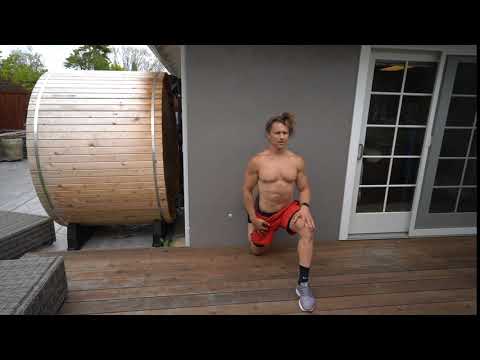
Ulkoinen video — Couch Stretch · Functional Bodybuilding.
How to do it
- Setup
- Kneeling lunge, rear shin up against a wall or couch/bench behind you, rear foot pointing up. Front foot flat on the floor, well out in front. Torso tall, ribs stacked over the pelvis.
- Execution
- Squeeze the rear glute to sink the hip forward and deepen the stretch. Hold completely still for the full prescribed time. This is a finisher drill only — never do it before lifting.
- Common error
- Arching the lower back to bring the torso closer to vertical instead of actually moving the hip forward — this fakes depth without touching the hip flexor. Keep the ribs pulled down and let the glute squeeze do the work.
- Feel
- A steady, building stretch through the front of the rear hip and thigh that should ease slightly the longer you hold it. Dull ache is normal. A sharp pinch in the hip means come out of the position, don't fight it.
75 s/puoli pito · lepo 0:15
Ohjelmassa: 75 s/puoli pito · lepo 0:15
RPE
Tavoite: 75 s/puoli pito · lepo 0:15
Nukkuva kyyhky
Passive hold, 60s each side.
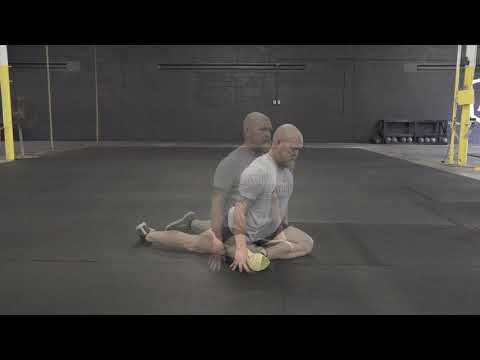
Ulkoinen video — PIGEON STRETCH · Atomic Athlete.
How to do it
- Setup
- Front leg bent, shin angled across your body with the front foot pointing toward the opposite hip. Back leg extended long behind you. Hips square to the floor, not twisted or hiked to one side.
- Execution
- Fold your torso forward over the front shin, letting your weight sink down. Hold still, breathing, for the full prescribed time.
- Common error
- Letting the hips rotate or hike up to force the front knee flatter — this fakes extra rotation from the hip instead of finding it honestly. Keep the hips square first, and accept whatever depth that leaves you with.
- Feel
- A deep stretch on the outside of the front hip and glute. A sharp pinch in the front of the hip crease means the angle is too aggressive — back the front shin off toward a less rotated position.
60 s/puoli pito · lepo 0:15
Ohjelmassa: 60 s/puoli pito · lepo 0:15
RPE
Tavoite: 60 s/puoli pito · lepo 0:15
Rintalihaksen venytys seinää vasten
45s each side.

Ulkoinen video — Pectoralis (Chest) Stretch · EmergeOrtho-Triangle Region.
How to do it
- Setup
- Stand side-on to a wall or doorway. Forearm flat against it, elbow bent roughly 90°, upper arm raised to that week's height — 90° (arm level with the shoulder) or 120° (arm angled up above shoulder height).
- Execution
- Keeping the forearm fixed on the wall, rotate your torso away from the wall until you feel the chest stretch. Hold for the prescribed time. Repeat at the second angle if the session calls for both.
- Common error
- Hiking the shoulder up toward the ear to fake more stretch — keep the shoulder blade pulled down and get the range from turning the torso, not from lifting the shoulder.
- Feel
- A steady stretch across the chest and front shoulder. Any sharp pinch inside the joint means back off the height or how far you rotate. Either shoulder sharpening at all is your signal to stop that side.
45 s/puoli pito · lepo 0:15
Ohjelmassa: 45 s/puoli pito · lepo 0:15
RPE
Tavoite: 45 s/puoli pito · lepo 0:15
Venytys: Käsivarsi rinnan yli
30s each side.

30 s/puoli pito · lepo 0:15
Ohjelmassa: 30 s/puoli pito · lepo 0:15
RPE
Tavoite: 30 s/puoli pito · lepo 0:15
Roikkuminen tangossa (Dead Hang)
30s, full relax through the shoulders and lats.

Ulkoinen video — Dead Hang · OPEX Fitness.
How to do it
- Setup
- Both hands on a pull-up bar, roughly shoulder-width, full overhand grip. Step or jump off the floor so your entire bodyweight hangs.
- Execution
- Consciously release any bracing, then check yourself against two signs of a true passive hang: your shoulders should ride up noticeably closer to your ears than when you're standing, and your ribcage should feel like it's lengthening away from your hips. If your shoulder blades are still pulled down and your neck looks the same as standing, you're still actively hanging — let it go and check the two signs again. Hang and breathe for the full prescribed time.
- Common error
- Actively pulling the shoulder blades down ('active hang') without noticing you're doing it — this is the default position most lifters hold from habit. The two-sign check in execution is how you catch it.
- Feel
- A gentle traction pulling through the shoulders and lats, grip working the forearms, shoulders visibly higher than your standing posture. Any pinching in the shoulder means come down and shorten the next hold.
30 s pito · lepo 0:15
Ohjelmassa: 30 s pito · lepo 0:15
RPE
Tavoite: 30 s pito · lepo 0:15